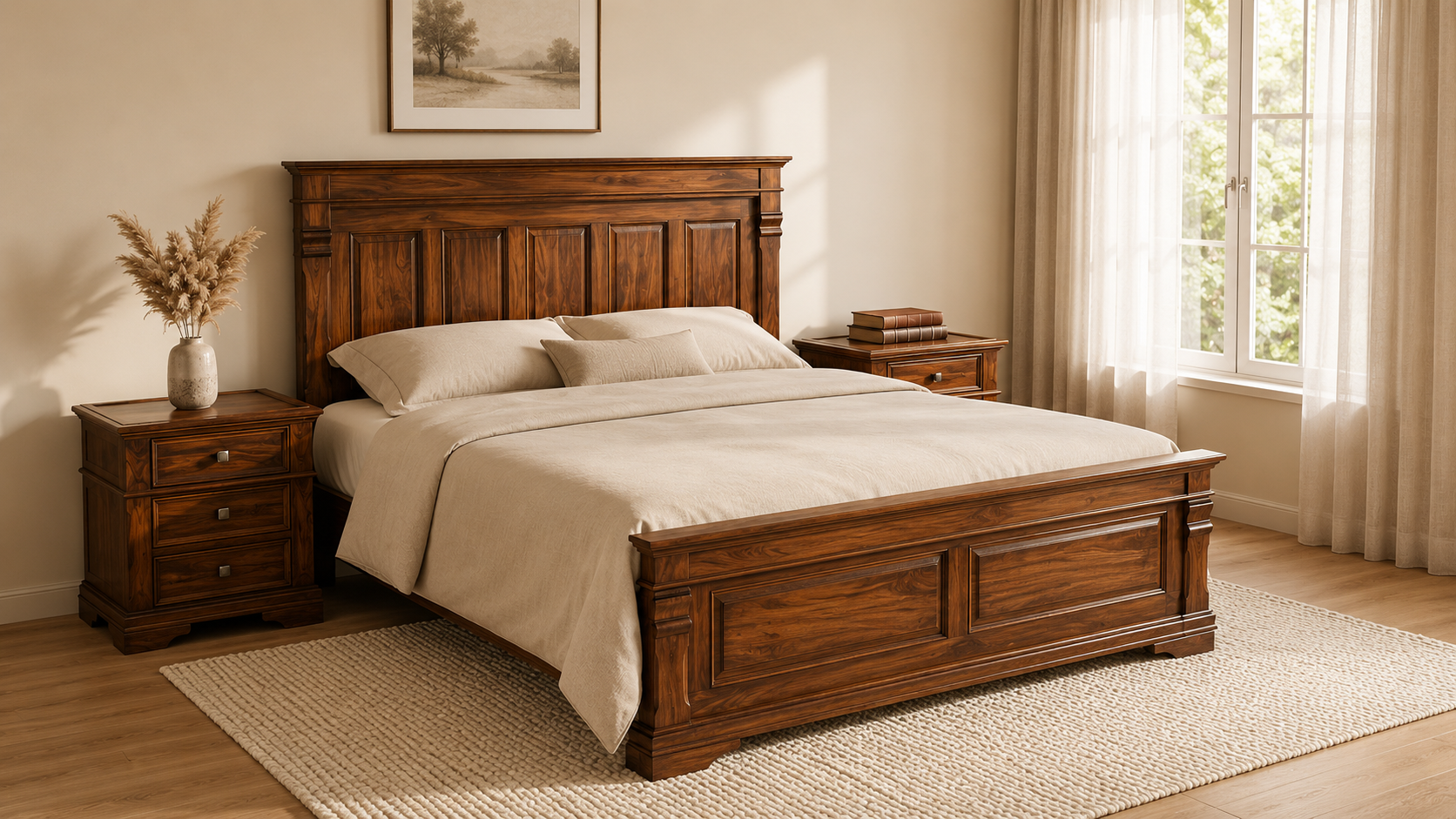
Bed buying guide
How to Buy a Bed in Pakistan
A good bed needs to fit your mattress, your room and the way you live. Use this guide to compare size, wood, upholstery, construction and complete bedroom sets before you place an order.

Founder of Pak Homes · Published August 7, 2026
Before you visit a showroom
Bed listings in Pakistan can look similar while describing very different products. One price may cover only the bed frame; another may include side tables, a dressing table and a mirror. A frame described as “wooden” may use solid wood throughout, a combination of solid wood and board, or an engineered structure with a wood finish. The safest approach is to decide your requirements first and then ask every supplier the same questions.
Start with the room and mattress, not the bed photograph. Measure the space, decide what furniture must remain around the bed, and confirm the exact mattress dimensions you already own or intend to buy. This prevents the most expensive mistake: ordering a beautiful frame that does not fit the room or mattress.
1. Measure the room and circulation space
Measure the wall where the headboard will sit, the distance to wardrobes and doors, and the usable walking space on both sides and at the foot of the bed. Remember that the frame is normally wider and longer than the mattress, especially when it has a thick upholstered headboard, broad side rails or carved posts.
Mark the proposed footprint on the floor with masking tape. Open wardrobe doors and room doors while the outline is in place. If you plan to add side tables, include them in the outline as well. This simple test gives a much more honest sense of scale than judging from a showroom.
2. Confirm the mattress size in inches
Names such as king, queen and double are not used consistently by every seller. A current Pakistani manufacturer, Diamond Supreme Foam, lists single at 78 × 42 inches, two queen widths at 78 × 60 and 78 × 66 inches, and king at 78 × 72 inches. Some sellers also use “double” for other dimensions. These examples are useful market references, not a universal Pakistan standard.
Ask for the bed's clear internal mattress space, not just its outside frame dimensions. Then compare that space with the mattress's exact length, width and thickness. Ideally, choose the mattress first or order the frame and mattress together from confirmed measurements. Never rely on “king” or “queen” alone.
Also ask how deeply the mattress sits inside the frame. A thick mattress can cover a large part of an upholstered headboard, while a thin mattress can sit uncomfortably low behind tall side rails. Leave enough space around the mattress to fit it without forcing the fabric or foam against the frame.
3. Choose the mattress for the sleepers—not the label
The mattress is the part that determines most of the sleeping feel; the bed frame supplies a stable foundation. “Hard,” “soft” and “orthopedic” are not enough information on their own. Firmness is subjective: the same mattress usually feels softer to a heavier person and firmer to a lighter person. Sleeping position matters too.
High-density foam
A familiar, widely available choice with relatively little bounce. Ask for the model, thickness, foam specification and written warranty—not simply “high density.” Low-quality foam can soften or form impressions earlier.
Memory foam
Contours more closely and generally isolates a partner's movement well. Dense memory foam can feel warmer, so hot sleepers should test the feel and ask what breathable or cooling layers are actually included.
Bonnell or connected spring
A traditional, bouncier spring construction that usually permits more airflow. Because the coils are connected, movement may travel more easily across the bed and quality depends heavily on the spring and comfort layers.
Pocket spring or hybrid
Individually wrapped coils can respond more locally and transfer less movement than a basic connected-spring unit. A hybrid combines springs with foam comfort layers, so ask what each layer is and how thick it is.
As a starting point, side sleepers often prefer more cushioning at the shoulder and hip, while back and stomach sleepers commonly need firmer support through the middle. Couples should test the mattress together because body weight, sleep position, heat and movement preferences may differ. If pain is persistent or medically significant, mattress marketing is not a diagnosis—ask an appropriate healthcare professional.
Before buying, lie in your normal sleeping position for more than a quick sit on the edge. Ask whether the model can be tried or exchanged, whether it is single-sided or double-sided, how often it should be rotated, and what foundation the warranty requires. A weak or widely spaced bed base can make even a good mattress sag.
4. Know the common woods and boards used in Pakistan
Pakistan's furniture market includes both solid timber and engineered boards. The Trade Development Authority of Pakistan describes solid woods such as rosewood/Sheesham and walnut in classical furniture, while modern furniture commonly uses MDF and chipboard. A bed can legitimately combine materials, but the combination should be stated clearly.
Sheesham (Dalbergia sissoo)
Also called shisham, tali or, in local trade, rosewood. It is valued for strength, visible grain, carving and polished furniture. Pakistan Forest Institute distinguishes pale sapwood from golden- to dark-brown heartwood; a polish colour alone cannot prove the species.
Keekar or kikar (Acacia nilotica)
A local hardwood used in furniture and structural components. It can make a strong frame when properly selected and seasoned. Ask whether the seller means solid keekar throughout or only in the supporting frame.
Deodar, kail and other timbers
Deodar (Himalayan cedar), kail/pine, walnut and other local or imported woods also appear in Pakistani furniture. Each differs in weight, grain, hardness, price and availability; the species name matters less than correct seasoning, sound sections and suitable construction.
MDF, chipboard, plywood and veneer
MDF and chipboard create smooth modern panels at a lower cost; plywood is built from bonded veneers and may be used for platforms, drawer boxes or panels. A decorative veneer or laminate can look like solid wood, so ask for the core material and edge sealing.
Engineered board is not automatically unsuitable, and solid wood is not automatically well made. Board quality, moisture protection, edge banding, hardware and where the board is used all matter. Structural legs and side rails face different loads from a decorative headboard panel or drawer front.
5. Verify seasoning, treatment and the solid-wood claim
Seasoning means reducing and balancing the wood's moisture before manufacture. Poorly seasoned timber can shrink, twist, split or open at joints after it enters a different room climate. Pakistani public furniture specifications commonly require seasoned, termite-treated and moisture-resistant wood; buyers can reasonably ask a supplier what drying and treatment process was used.
For Sheesham, heartwood and sapwood are not equal. Pakistan Forest Institute notes that the pale sapwood is distinct from the darker heartwood, and its research describes sapwood as less durable and more susceptible to insects and fungi. This does not mean every light area is defective, but a heavily stained finish can conceal colour variation, filler and mixed materials.
Inspect an unfinished edge, the underside, the back of the headboard and the inside of fixing holes where possible. Natural grain should continue rather than repeat like printed laminate. End grain on a solid board looks different from a veneered or laminated edge. Do not damage showroom furniture to test it—ask the seller to demonstrate the construction or provide workshop photographs.
6. Inspect construction, not only decoration
Check the joints
The frame should feel stable when gently pushed. Ask how the side rails connect and whether the fittings can be tightened after moving the bed.
Look underneath
Review the centre support, legs, slats or platform beneath the mattress. A large mattress needs support through the middle, not only around its edges.
Inspect the finish
Look for an even polish, clean corners and properly finished hidden edges. Ask how to clean the surface and whether the final colour can vary from the sample.
Ask about assembly
Confirm whether delivery includes carrying, assembly and adjustment, especially for apartments, narrow staircases and out-of-city orders.
7. Choose between plain, carved and upholstered designs
A plain wooden bed is usually easier to coordinate with changing décor and easier to dust. Carved and Chinioti-inspired beds create a stronger visual statement, but their detail needs more cleaning and may make the frame feel larger in a compact room.
Upholstered headboards are comfortable for reading and soften the look of a bedroom. Before ordering, ask for the fabric type, colour options, foam density, cleaning method and whether the fabric panel can be replaced later. Homes with children, pets or significant dust may benefit from a durable, tightly woven and easier-to-clean fabric.
8. Know what is included in a bedroom set
“Bed set” and “complete bedroom set” do not guarantee the same components. A set may include two side tables and a dressing table, while the mattress, wardrobe, bench or mirror may be excluded. Request a written list of every included piece and the dimensions of each item.
Compare the total value, not only the headline price. If your room cannot comfortably fit a large dressing table or both side tables, ask whether the supplier can sell or make only the pieces you need. A smaller, well-planned set is better than paying for furniture that blocks circulation.
9. Compare price on the same specification
Bed prices vary with size, wood species and quantity, upholstery, carving, polish, included furniture, customization and delivery city. A low quote is not automatically better if it covers a different material or fewer pieces. Ask for the specification and final payable amount in writing before comparing suppliers.
Confirm whether the quoted price includes taxes, delivery, upstairs handling, assembly and any city-specific transport charge. For made-to-order furniture, ask about the deposit, balance-payment stage, production time and what happens if the delivered colour or dimensions differ from the approved order.
10. Check delivery, access and after-sales support
Share your city, floor number, lift size, staircase access and doorway measurements before dispatch. Ask whether the bed arrives assembled or in sections and who is responsible if a piece cannot pass through the entrance.
Keep the order confirmation, dimensions, material description, finish choice, fabric reference and promised delivery date in one written message or invoice. Before the delivery team leaves, inspect the frame for movement, finish damage, missing fittings and alignment. Take photographs immediately if anything needs correction.
11. Common bed-buying pitfalls in Pakistan
Buying “wooden” without a material breakdown
The visible frame may be solid wood while large panels, the dressing table or side tables use MDF or chipboard. Ask for the material of each major component in writing.
Trusting polish colour as proof of wood
A dark Sheesham-style polish can be applied to another timber, veneer or board. Colour is a finish choice, not a species test.
Ignoring seasoning and moisture
Fresh or poorly dried wood can move after delivery. Ask how the timber was seasoned and inspect for open joints, twisting, cracks, damp storage or a strong musty smell.
Assuming “termite proof” means permanent protection
Sheesham has useful natural resistance, but no wooden bed should be treated as invulnerable. Treatment, dry conditions and inspection still matter; termite research also links moisture with termite survival and damage risk.
Ordering by king or queen name alone
Local size names vary. Write the internal mattress opening, outside frame size and mattress thickness on the order.
Forgetting the centre support
A wide bed needs a properly supported centre rail, adequate legs and a suitable slat or platform system. Otherwise the base, frame or mattress can dip in the middle.
Confusing a long warranty with broad coverage
Mattress warranties often define covered sagging, required foundations, stains, rotation and other exclusions. Ask for the actual written terms and invoice rather than relying on “lifetime warranty.”
Comparing incomplete prices
One quote may exclude the mattress, mirror, side tables, delivery, assembly or transport outside the seller's city. Compare final delivered specifications line by line.
How to check a bed at delivery
Before signing off, compare the delivered pieces with the written order. Measure the internal mattress opening and overall frame, count all set components, check that the headboard and footboard match the selected design, and confirm the approved polish and upholstery reference.
Place the assembled bed on a level floor and press each corner. It should not rock excessively or produce repeated joint movement. Check the centre rail and its floor supports, run a hand carefully along accessible edges for roughness, inspect the finish in daylight, and photograph any crack, dent, colour mismatch or missing fitting before the delivery team leaves.
For the mattress, verify the model, size, thickness, manufacturing label and warranty card before removing protective packaging. Check the seller's return rules first: opening or damaging packaging may affect what can be returned.
Questions to ask the supplier
What exactly is included?
Bed only, or bed with side tables, dressing table, mirror, wardrobe or another piece?
What are the exact dimensions?
Request the outside frame size and the inside mattress size in inches, plus the dimensions of every set component.
Which materials are used where?
Confirm the wood or board used in the frame, supports, headboard, side tables and dressing unit.
What is the final delivered price?
Include customization, upholstery, transport, assembly and any charges outside the supplier's home city.
A practical final rule
Choose the bed that is easiest to verify, not simply the one with the most impressive photograph. Exact dimensions, clearly named materials, a written component list and an agreed delivery process are signs of a safer purchase.
When you are ready to compare designs, explore the Pak Homes beds collection. Open each listing to review its available information, then contact the listed partner to confirm specifications, stock, current pricing and delivery for your city.
Research notes and sources
This guide combines Pakistan-specific government and industry material with independent mattress guidance. Useful references include the Pakistan Forest Institute profile of Shisham, the Institute's 2023–24 forestry research report, the Trade Development Authority furniture-industry report, and research on wood seasoning and termite resistance involving major Pakistani furniture woods.
For mattress market examples, see the sizes offered by Diamond Supreme Foam and the Pakistan-focused comparison of foam and spring construction from Master MoltyFoam. Brand pages describe their own products and should be treated as seller information. The general guidance on firmness, body weight, sleeping position and purchase policies comes from the independent Sleep Foundation mattress-shopping guide.